Medicare Advantage Star Ratings in Florida: How to Compare Plans for 2027
Choosing a Medicare Advantage plan in Florida for 2027 is not simply about finding the lowest premium or the largest list of extra benefits. A plan’s Medicare Advantage star rating
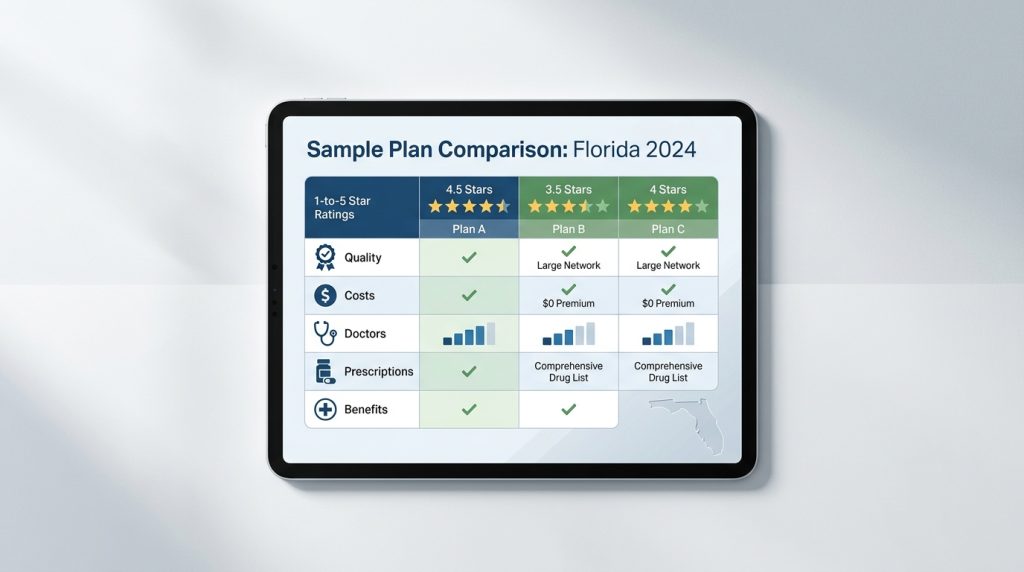
Choosing a Medicare Advantage plan in Florida for 2027 is not simply about finding the lowest premium or the largest list of extra benefits. A plan's Medicare Advantage star rating can give you another important way to judge quality, but the rating is only useful when you understand what it measures and how it fits with your own healthcare needs.
For 2027, the timing matters even more. Medicare says people can begin comparing 2027 plans on Medicare.gov starting October 1, 2026, while the 2027 Medicare health and drug plan Star Ratings are expected to be available around October 8. Medicare Open Enrollment then runs from October 15 through December 7, 2026.
If you are looking at Medicare Advantage star ratings in Florida, this guide explains what the ratings mean, how Medicare Advantage plans are rated, what is changing for 2027, and how to compare a plan's rating with its doctors, prescriptions, costs, network, and benefits.
What Are Medicare Advantage Star Ratings?
Medicare Advantage Star Ratings are a quality measurement system used by the Centers for Medicare & Medicaid Services (CMS) to help people compare the quality and performance of Medicare Advantage and Medicare Part D plans. Plans receive ratings from 1 to 5 stars, with 5 stars representing the highest rating. CMS evaluates plans using multiple measures related to areas such as health outcomes, preventive care, chronic disease management, member experience, and access to care. The purpose is not to tell you which plan is automatically best for every person. Instead, the CMS Medicare Advantage Star Ratings provide another piece of information that can help you compare plans alongside their benefits and costs. A simple way to understand the Medicare Star Rating system is:- 5 stars: Excellent
- 4 stars: Above average
- 3 stars: Average
- 2 stars: Below average
- 1 star: Poor
How Are Medicare Advantage Plans Rated?
CMS evaluates Medicare Advantage plans using a broad set of quality and performance measures. For 2026 Star Ratings, Medicare Advantage Prescription Drug (MA-PD) contracts were rated on up to 43 measures, while Medicare Advantage-only contracts were rated on up to 33 measures. These measures fall across five broad categories: outcomes, intermediate outcomes, process, patient experience, and access. The exact measures and methodology can change over time, which is important when you are researching Medicare Advantage ratings in Florida for a new plan year.Health outcomes and chronic conditions
Some measures examine whether plans help members manage their health and chronic conditions. This can include areas such as diabetes care, medication management, preventive care, and other clinical outcomes. These measures are important because a plan's quality is not only about how quickly someone can reach customer service. It is also about whether members receive appropriate care and achieve better health outcomes.Preventive care
Medicare Advantage quality ratings also consider preventive services and other measures designed to help members stay healthy. Preventive care can include screenings, vaccinations, and other recommended services. These measures can give beneficiaries an indication of how effectively a plan supports preventive healthcare.Member experience
CMS also considers information about members' experiences with their health plans. This can include areas related to communication, access to care, getting needed information, and satisfaction with aspects of the plan. This matters because two plans can have similar benefits on paper but provide very different experiences for members.Access to care
Access-related measures look at whether members can obtain appropriate healthcare and services. Access is especially important for people who regularly see specialists or manage multiple health conditions. When comparing plans, however, you should also check the actual provider network for your ZIP code. A strong overall rating does not guarantee that your personal doctors or preferred hospital participate in the plan.What Are the Medicare Advantage Star Ratings for 2027?
For someone shopping for Medicare Advantage plans in Florida for 2027, it is important to distinguish between the Star Ratings methodology and the rating displayed for a particular plan. CMS has finalized changes to the Star Ratings program for 2027. The changes are intended to place more emphasis on meaningful clinical quality, health outcomes, and patient experience while reducing measures that provide little useful differentiation between plans. CMS also confirmed that the 2027 Star Ratings will not implement the previously planned Excellent Health Outcomes for All reward, formerly referred to as the Health Equity Index reward. CMS will instead continue using the historical reward factor while the Star Ratings system is streamlined. Another important change is the removal of 11 measures focused on administrative processes or areas where plan performance showed limited meaningful variation. CMS is also adding a Part C Depression Screening and Follow-Up measure beginning with the 2027 measurement year, with the corresponding Star Rating impact beginning later under the finalized methodology. This means you should not assume that a plan's rating from an older year tells you exactly how the same plan will be rated for 2027. When comparing coverage for 2027, use the current rating displayed for the specific plan and plan year on Medicare's official comparison tools.Why Do Star Ratings Matter When Comparing Florida Medicare Advantage Plans?
Florida beneficiaries have many Medicare Advantage options, but having more choices can also make comparison harder. CMS reports that nearly all Medicare beneficiaries will have access to at least one Medicare Advantage plan in 2027, and 97% are expected to have access to 10 or more options. CMS also says people can begin shopping and comparing 2027 plans on Medicare.gov before Open Enrollment begins. With that many choices, a quality rating can help you narrow your options. For example, suppose you find three plans available in your Florida ZIP code. All three have similar premiums, but one has a 5-star rating, another has 4 stars, and the third has 3 stars. That does not mean you should automatically choose the 5-star plan. Instead, use the ratings to identify plans worth examining more closely. Then compare the details that affect your healthcare directly. A practical comparison should include:- Star rating
- Monthly premium
- Deductible
- Copayments and coinsurance
- Maximum out-of-pocket limit
- Doctors and specialists
- Hospitals
- Prescription medications
- Pharmacy network
- Dental, vision, and hearing benefits
- Referral and prior authorization rules
- Plan type, such as HMO or PPO
Are 5-Star Medicare Advantage Plans in Florida Always the Best Choice?
No. A 5-star Medicare Advantage plan is highly rated by CMS, but that does not automatically make it the best choice for every Florida beneficiary. The Star Rating measures the plan's performance against CMS quality measures. It does not know which doctor you prefer, which prescriptions you take, which hospital you use, or how much you are willing to pay for specific services. Consider two hypothetical Florida beneficiaries. One person rarely visits a doctor, takes only a few medications, and values a broad provider network. Another person sees several specialists, takes multiple prescriptions, and regularly uses medical services. They may reasonably choose different Medicare Advantage plans even if one plan has a higher Star Rating. This is why Medicare Advantage quality ratings should be viewed as one part of the decision rather than the entire decision.How to Compare Medicare Advantage Star Ratings in Florida for 2027
The best way to compare plans is to start with your own healthcare needs and then use the Star Rating as one of several comparison points.1. Enter your Florida ZIP code
Medicare Advantage plans are not identical throughout Florida. Plan availability, premiums, provider networks, and benefits can vary by service area. Start your comparison using your actual ZIP code rather than relying on statewide averages.2. Check the plan's Star Rating
Review the current Star Rating displayed for the plan you are considering. Do not rely on an old article, advertisement, or previous year's rating when making a 2027 decision. CMS publishes annual Star Rating information, and the 2027 ratings are scheduled to become available on Medicare.gov around October 8, 2026.3. Check your doctors
A high Star Rating is not useful if your preferred doctor is outside the plan's network or if seeing that doctor would create significantly higher costs. Check your primary care physician, specialists, preferred hospital, and other providers you use regularly.4. Check your prescriptions
If you take prescription medications, review the plan's formulary and pharmacy network. Confirm that your medications are covered and check their cost-sharing requirements. A plan that looks attractive because of its Star Rating or premium could become more expensive if your prescriptions fall into higher-cost tiers.5. Compare your likely healthcare costs
Look beyond the monthly premium. Consider the costs you are most likely to encounter during the year, including specialist visits, hospital care, diagnostic services, prescriptions, and other healthcare services you regularly use. Also review the plan's annual maximum out-of-pocket limit for covered medical services.6. Review the plan's benefits and rules
Additional benefits can be useful, but make sure you understand the actual terms. Review benefits such as dental, vision, hearing, transportation, and other supplemental benefits. Also check whether referrals or prior authorization may apply to services you expect to use.7. Compare the complete picture
Once you have reviewed quality, providers, prescriptions, benefits, and costs, compare your remaining choices. The goal is not to find the plan with the highest rating in isolation. The goal is to find a plan with strong quality that also fits your healthcare needs and budget.What Changed in the Medicare Star Rating System for 2027?
The 2027 changes are important because they show how CMS is evolving the way Medicare Advantage quality is measured. CMS says the revised system is being refocused on clinical care, health outcomes, and patient experience. Measures that focus heavily on administrative processes or provide little meaningful distinction between plans are being removed. CMS is also adding a new Part C Depression Screening and Follow-Up measure to address behavioral health gaps. At the same time, CMS is retaining the Diabetes Care – Eye Exam measure because of its importance in preventing serious complications. For consumers, the practical takeaway is simple: do not assume the Star Ratings system stays exactly the same every year. The measures, methodology, and plan performance can change. That is another reason to check the current information when shopping for 2027 coverage.Star Rating vs. Cost: Which Should Matter More?
Neither should automatically win. A low-premium Medicare Advantage plan can be attractive, but the premium alone does not tell you what the plan will cost when you use healthcare services. Likewise, a high Star Rating does not tell you whether the plan has your preferred providers or covers your medications at an affordable cost. Think of the comparison in layers. First, determine which plans are available where you live. Then look at quality. After that, compare your doctors, hospitals, prescriptions, costs, and benefits. For example, if Plan A has a higher rating but excludes your primary specialist, while Plan B has a slightly lower rating and includes your doctors and medications at a manageable cost, Plan B may be a better personal fit. The right Medicare plan is not necessarily the plan with the highest number of stars. It is the plan that provides an appropriate combination of quality, access, coverage, and cost for your circumstances.A Simple 2027 Medicare Advantage Comparison Checklist
Before enrolling in a Medicare Advantage plan in Florida, review the plan from both a quality and personal-fit perspective. Check:- The plan's current 2027 Star Rating
- Your primary care doctor
- Your specialists
- Your preferred hospitals
- Your prescription medications
- Your preferred pharmacies
- Monthly premium
- Deductible
- Copayments and coinsurance
- Maximum out-of-pocket limit
- Dental benefits
- Vision benefits
- Hearing benefits
- Referral requirements
- Prior authorization requirements
- HMO or PPO plan structure
- Service area