How to Choose a Medicare Advantage Plan in Florida: 10 Things to Check Before Enrolling
Choosing a Medicare Advantage plan in Florida can feel overwhelming. In 2026, Florida has 611 Medicare Advantage plans available, and every person with Medicare in the state has access to
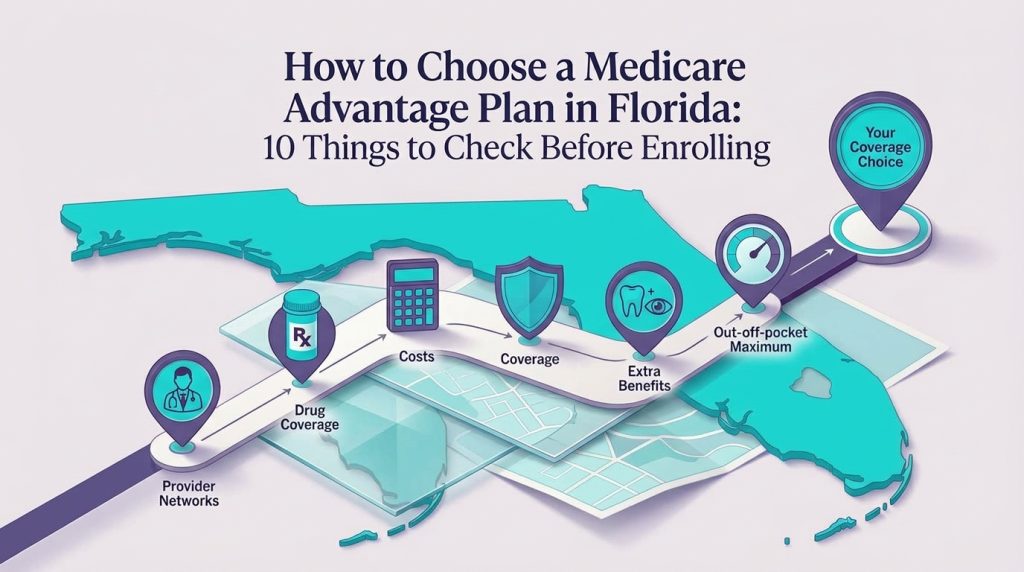
Choosing a Medicare Advantage plan in Florida can feel overwhelming. In 2026, Florida has 611 Medicare Advantage plans available, and every person with Medicare in the state has access to at least one plan with a $0 monthly premium. With so many options, the lowest advertised premium is not enough to tell you whether a plan fits your healthcare needs.
The better approach is to look at the full picture: your doctors, hospitals, prescriptions, monthly costs, out-of-pocket maximum, plan network, extra benefits, and how often you expect to use healthcare.
If you are learning how to choose a Medicare Advantage plan in Florida, this guide explains the most important factors to check before enrolling. It also shows how to compare plans based on your own healthcare needs instead of choosing simply because a plan advertises a $0 premium.
This process is more useful than comparing plans based on a single number.
What Is a Medicare Advantage Plan?
Medicare Advantage, also called Medicare Part C, is a Medicare health coverage option offered by private insurance companies approved by Medicare. Medicare Advantage plans cover Medicare Part A and Part B services and generally use a specific network of doctors, hospitals, and other healthcare providers. Many Medicare Advantage plans also include prescription drug coverage and additional benefits that may include dental, vision, hearing, fitness, transportation, or other services. However, benefits and costs vary from one plan to another, so it is important to review the details of each plan available in your area. In Florida, plan availability can vary by location. A plan available in one Florida county may not be offered in another, and the provider network and costs can also differ. That is why a Medicare Advantage plan comparison in Florida should be based on your ZIP code and personal healthcare needs rather than a statewide list alone.How to Choose a Medicare Advantage Plan in Florida
There is no single Medicare Advantage plan that is right for everyone. The plan that works well for one person may not work as well for someone with different doctors, prescriptions, healthcare needs, or travel habits. Before enrolling, compare the following 10 factors.1. Compare the Total Cost, Not Just the Monthly Premium
A $0 monthly premium can be attractive, but it should be only one part of your comparison. Medicare Advantage plans can have different premiums, deductibles, copayments, coinsurance, and other costs. You must also continue paying your Medicare Part B premium while enrolled in Medicare Advantage. Medicare.gov states that Medicare Advantage costs and out-of-pocket limits vary by plan. Think about how you actually use healthcare. Someone who rarely visits a doctor may have different priorities from someone who regularly sees specialists, takes several medications, or expects medical procedures during the year. When choosing a Medicare Advantage plan, look at the cost of the services you are most likely to use rather than comparing premiums alone. For example, two plans could both have a $0 monthly premium but have different costs for specialist visits, hospital stays, diagnostic services, or prescription drugs. The plan with the lowest premium may not have the lowest total yearly cost for your situation.What Medicare Advantage plan costs should you compare?
Look at:- Monthly plan premium
- Medicare Part B premium
- Annual deductible, if applicable
- Primary care copay
- Specialist copay
- Hospital costs
- Prescription drug costs
- Coinsurance
- Annual out-of-pocket maximum
2. Make Sure Your Doctors Are in the Plan's Network
Your Medicare Advantage provider network can have a major effect on your healthcare experience. Before enrolling, check whether your primary care doctor, specialists, medical groups, and other providers you regularly use participate in the plan. Medicare.gov specifically recommends checking whether your providers are in-network when you have Medicare Advantage. This step is particularly important if you have an established relationship with a doctor or specialist. Do not assume that because a hospital is listed in a plan's network, every doctor who works at that hospital is automatically in-network. Verify the specific provider and, when appropriate, the medical group as well. For example, if you regularly see a cardiologist at a large Florida hospital, check the cardiologist's network status rather than checking only the hospital name.3. Check Your Preferred Hospitals and Healthcare Facilities
Doctors are not the only providers you should check. Think about where you would want to receive care if you needed surgery, specialist treatment, diagnostic testing, rehabilitation, or hospital services. Then check whether those facilities participate in the plan. This becomes especially important if you already receive treatment for an ongoing condition. Different Medicare Advantage plans can have different networks. HMOs generally require you to receive covered care from providers in the plan's network, except in situations such as emergencies, urgent care, or other circumstances specified by the plan. PPOs generally allow out-of-network care for covered services, but you will usually pay more.4. Review Medicare Advantage Prescription Drug Coverage
If you take prescription medications, drug coverage should be one of the first things you compare. Many Medicare Advantage plans include Part D prescription drug coverage, but the details can vary significantly between plans. A medication may be covered under one plan and have different cost-sharing or coverage requirements under another. When reviewing Medicare Advantage prescription drug coverage, check your complete medication list. Include the name, dosage, and frequency of each prescription. Then look at:- Whether each medication is covered
- Which drug tier it falls into
- Your expected copay or coinsurance
- Whether the plan has coverage restrictions
- Which pharmacies are preferred or in-network
- Whether mail-order options are available
5. Understand the Plan's Out-of-Pocket Maximum
The Medicare Advantage out-of-pocket maximum is one of the most important numbers to review. Medicare Advantage plans have an annual limit on what you pay for covered Medicare services. Once you reach your plan's limit, the plan pays 100% of your covered Medicare services for the rest of the calendar year. The limit varies by plan. This gives you an important way to compare the financial risk of different plans. For example, imagine two plans have similar monthly premiums, but one has a significantly different maximum out-of-pocket limit. If you need substantial medical care during the year, that difference could matter much more than a small difference in monthly premiums. When comparing plans, find the out-of-pocket maximum and understand whether the plan has separate limits for in-network and out-of-network services.6. Compare HMO and PPO Plan Rules
Understanding the type of Medicare Advantage plan can make comparison easier. An HMO, or Health Maintenance Organization, generally requires you to use doctors and facilities within the plan's network for covered care, except for certain situations. Some HMO plans may also require referrals before you see certain specialists. A PPO, or Preferred Provider Organization, also has a provider network, but it generally allows you to receive covered services from out-of-network providers at a higher cost. PPO plans generally offer more flexibility when using providers outside the network. Neither structure automatically makes a plan appropriate for everyone. Consider how important provider flexibility is to you. If you already have doctors you want to keep, start with the network. If you frequently travel or want more flexibility in choosing providers, carefully review the plan's out-of-network rules.7. Look Carefully at Dental, Vision and Hearing Benefits
Extra benefits are one reason many people consider Medicare Advantage, but the details matter. A plan may advertise dental, vision, or hearing benefits, but you should check exactly what those benefits cover, how much the plan pays, and whether restrictions apply. For example, dental coverage may distinguish between preventive services and more extensive procedures. Vision benefits may include an allowance for eyewear rather than unlimited coverage. Hearing benefits may have specific limits or participating providers. Instead of asking only, "Does this plan offer dental coverage?" ask: What does the dental benefit actually cover, and what will I pay? Apply the same approach to vision, hearing, fitness, transportation, and other additional benefits.8. Check the Plan's Medicare Star Rating
Medicare Star Ratings can provide another useful piece of information when comparing Medicare Advantage plans. CMS uses Star Ratings to measure the quality and performance of Medicare Advantage and Part D plans across areas such as member experience, access to care, and other health and service measures. A plan's rating should be considered alongside its network, costs, prescription coverage, and benefits. It should not replace those factors. The most useful comparison is one that considers the overall plan details that matter to you.9. Consider How You Use Healthcare Throughout the Year
A good Medicare Advantage plan comparison should reflect your expected healthcare use. Start by looking at your recent healthcare history. How often did you visit your primary care doctor? How frequently did you see specialists? Did you have hospital visits, tests, therapy, or other services? Do you expect similar healthcare needs in the coming year? Someone who rarely needs medical care may focus more on premiums and routine costs. Someone who regularly sees specialists may place greater importance on specialist copays, provider networks, prior authorization requirements, and the out-of-pocket maximum. This approach helps you compare plans based on real-world use instead of focusing on promotional benefits that you may never need.10. Check the Plan's Availability in Your Florida County and ZIP Code
Florida is a large Medicare market, and plan choices are not identical across the state. CMS reports that 611 Medicare Advantage plans are available in Florida for 2026, but that does not mean every Florida resident can choose from all 611 plans. Plan availability depends on location and service area. That means you should not choose a plan simply because a friend, relative, or neighbor has it. A plan that works for someone in one Florida county may not have the same availability, provider network, premium, benefits, or prescription coverage where you live. Use your ZIP code when comparing plans and verify the specific plan information for your area.A Simple Way to Compare Medicare Advantage Plans
Once you have identified the plans available in your area, create a side-by-side comparison based on the factors that matter most to you. Start with your doctors, hospitals, prescriptions, and expected healthcare use. Then compare costs and plan rules. A simple comparison can look like this:| What to Check | Why It Matters |
| Monthly premium | Shows your regular plan cost |
| Part B premium | You generally continue paying this while enrolled |
| Doctor network | Helps you keep preferred doctors |
| Hospital network | Important for planned and unexpected care |
| Prescription coverage | Determines whether your medications are covered and at what cost |
| Specialist costs | Important if you regularly see specialists |
| Out-of-pocket maximum | Shows your annual limit for covered Medicare services |
| HMO or PPO | Affects provider flexibility and network rules |
| Dental, vision and hearing | Shows what additional benefits are actually included |
| Star Rating | Provides information about plan quality and performance |
| Prior authorization | May affect access to certain services or treatments |
| Service area | Confirms whether the plan is available where you live |
What to Look for in a Medicare Advantage Plan if You Have Regular Medical Care
If you frequently use healthcare services, focus on the parts of the plan that can affect your total yearly spending and access to care. Start with your existing doctors and hospitals. Then review specialist costs, hospital costs, prescription coverage, prior authorization rules, and the annual out-of-pocket maximum. For someone managing an ongoing health condition, a plan's provider network may be particularly important because changing plans could affect access to existing providers. The goal is not simply to find a plan with the lowest advertised price. It is to find a plan whose network, benefits, rules, and costs make sense for the care you expect to receive.What to Look for in a Medicare Advantage Plan if You Rarely Use Healthcare
If you rarely visit doctors and take few or no prescriptions, your comparison may look different. You may place more importance on the monthly premium, routine care costs, prescription coverage, provider access, and the plan's out-of-pocket maximum. However, it is still important to consider unexpected healthcare needs. A plan that looks inexpensive during a healthy year can have different financial consequences if you suddenly need hospitalization or specialist care. Review the plan's cost-sharing structure before making a decision.Don't Choose a Plan Based Only on a $0 Premium
$0-premium Medicare Advantage plans are widely available in Florida. CMS reports that 100% of people with Medicare in Florida have access to a $0-premium Medicare Advantage plan in 2026. But a $0 premium does not mean you pay nothing for healthcare. You may still have costs for doctor visits, specialists, hospital services, prescriptions, and other covered care. You also continue to pay your Medicare Part B premium. For that reason, the better question is not: "Which Medicare Advantage plan has a $0 premium?" It is: "What will this plan likely cost me based on the healthcare I actually use?" That shift can make Medicare Advantage plan comparison much more meaningful.Questions to Ask Before Enrolling in a Medicare Advantage Plan
Before you enroll, make sure you can answer these questions about the plan you are considering:- Are my primary care doctor and specialists in-network?
- Are my preferred hospitals and healthcare facilities in-network?
- Are all of my prescriptions covered?
- What will I pay for my most common doctor visits?
- What will I pay when I see a specialist?
- What is the annual out-of-pocket maximum?
- Does the plan use an HMO or PPO structure?
- Do I need referrals for specialists?
- Does the plan require prior authorization for certain services?
- What dental, vision, and hearing benefits are included?
- Is the plan available in my ZIP code?
- How does the plan compare with my current coverage?